A primary necessity for the Christian life is to stay centered on Christ in all things. It is only in the purifying light of God that we see light, and become enlightened. “The lamp of the body is the eye. If therefore your eye is good, your whole body will be full of light.”1 By abiding in this light the Christian believer is empowered to discern true reality. Only when our spiritual vision is renewed in the Divine Light of the Holy Trinity are we able to act in accordance with the Truth. Even more so, the person being illumined goes beyond acting in accordance with Truth, indeed, they move into abiding in the Truth. The continual incarnation of Truth through and in the Church to this world is only possible within the all revealing Light of the Holy Trinity: “For with Thee is the fountain of life, and in Thy light we see light.”2
When persons within the Church cease lifting their eyes up to the lustrating energy of God, they fall into darkness and this darkness is great and of the worst kind. “But if your eye be bad, your whole body will be full of darkness. If the light that is in you is darkness, how great the darkness!”3The inner eyes of a person become blind to the things of God and are no longer able to discern true reality; it is then that the shadows of this fallen world are taken to be substantial and the only “reality.” When this happens within the institution of the Church the result is devastating.4 The inner eyes (nous) become blinded by darkness and are cast into the abyss of existing in non-reality. This is the result of the eyes of the heart ceasing to focus on Christ Jesus, and becoming fixated on this temporal world. “Where your heart is, there your treasure will be also.”5

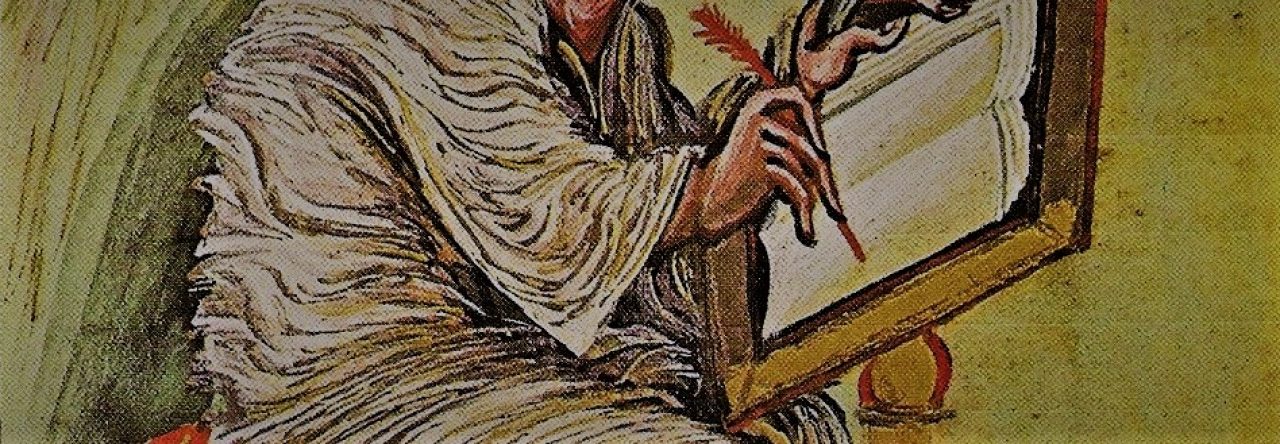
In the early 700’s, a loss of vision steadily arose and manifested in a heresy known as Iconoclasm (to break icons). Iconoclasm is against all pious depictions in image of Christ Jesus, the Virgin Mary or any saint, in a word it is against holy images, also called icons. It taught that icons are idolatry and forbade their veneration. This false teaching was divinely repudiated in the Church through the 7th Ecumenical Council and subsequently in what is known as the Triumph of Orthodoxy in 843AD. Iconoclasm in its essence is the sad loss of divine vision. It is a blinding of the spiritual eyes to the true revelation of salvation as it relates to both humanity and the whole material world. What facilitated the loss of divine vision at that time? It could be that external historical events, such as the rise of Islam, severe natural disasters, and the growing gap between Eastern and Western Christianity caused the Iconoclasts to take their eyes off of Christ Jesus. It is not uncommon that in times of tribulation people begin to focus on the storm around them and cease gazing on Christ. In the midst of testing, if a person fails to refocus on Christ– reorientate, repent– true vision may be darkened by unbelief and if not healed, it can be lost. Whatever the reasons may have been, the rejection of Christian imagery–icons–betrays a tragic falling away from true reality and a loss of clear spiritual sight.
One of the many characteristics of the icon is the fact that it is a material herald of true reality and life. It is the apex of the symbolic essence of created nature. St. Dumitru Staniloae writes, “The value of the world as a road to God is explained by the fact that man must have an object of giant proportions for strengthening his spiritual forces, but also from the intrinsic structure of the world as a symbol of transcendent divine realities. A symbol (from the Greek, symballein, to throw together, to unite two things without confusing them), is a visible reality which doesn’t only represent, but somehow makes an unseen reality visible. A symbol presupposes and shows two things simultaneously. It is ‘a bridge between two worlds,’ as somebody has noted.”6 It is also a focal point reflecting the sanctification of humanity and the material world through the Divine Incarnation of the Lord Jesus Christ. “Holiness is the realization of the possibilities given to man by the Divine Incarnation, an example to us: the icon is the means of the revealing this revelation … In other words, the icon transmits visually the realization of the patristic formula … ‘God became man so that man should become god.'”7 Redeemed mankind, when dwelling in the reality of transformation into the image of Christ, through the Body of the Church, is able, by grace, to take up the sensible and material created order and reinvigorate and unite it with its authentic vision and purpose. The created material world, through the redemptive work of Christ, may once again fully achieve its original God given intent: to be a vehicle and participator in the glory and power of God. St. John of Damascus writes: “I reverence the rest of matter and hold in respect that through which my salvation came because it is filled with divine energy and grace.”8 St. Dumitru says, “The alliance of these two worlds [the immaterial and the material, my note], the possibility of their interpenetration, the transfusion of energy from one world into the other, are all communicated to us by means of this symbolic sign. The symbol unveils for us the life of God and signifies for us the entrance of divine energy into the life of this natural world.”9
The icon is one of the most potent examples of the redeemed cosmos in Christ Jesus, infused once again with divine potential and power. It presents to mankind the pure vision of revelation, portraying with matter those things which are everlasting and essential. The reality is that this world is being penetrated by the eternal and that death, sin, and corruption are no longer lords over mankind and creation. The icon cries out: “Death is swallowed up in victory. O Death, where is your sting? O Hades, where is your victory?”10 It stands as an invitation for all to enter into genuine reality and being; it is the trophy of the resurrection and through it the already existent setting aright and purification of creation. This entails rejecting the call and temptation of this fallen world to live in a state of non-being by following the fallen carnal desires and thereby choosing the non-existence of falsehood. To dwell outside of the revealed divine reality is to dwell away from God Who is Life. Such become ossified in materialism which is inevitably iconoclastic.
Iconoclasm, the rejection of icons, directly results from a loss of divine vision and reality. It not only breaks and rejects image in Christian worship but inevitably deconstructs the images in created material order, reducing and breaking them to their most base states.
After initially being a strong champion of the icon, the European West was heavily impacted by the Iconoclast spirit. If any segment of Christianity begins to desire and focus on earthly power and prestige, the end result is a loss of heavenly vision. The rise of Charlemagne in the late 700’s in the west may be considered a beginning point for this decline of vision. At the “council” of Frankfurt in 794AD Charlemagne led an attack and condemnation on holy icons. This assembly allowed that images could be used for “educational purposes”, but it soundly rejected the Christian tradition of venerating icons together with the profound theology that informs it. This assembly also defended the emerging Frankish use of the Filioque.
Only six years later, in 800AD, the Pope of Rome crowned Charlemagne as the “holy Roman Emperor.”11 Of course, these historical events are varied and complex, but it suffices to note this era as the beginning of a period of major spiritual alterations for the Western Church. Sadly, unlike in the East, the West eventually failed to counter the Iconoclast spirit and it came to dominate. This loss of spiritual vision became increasingly evident in the artistic expression of the West. The Iconoclast spirit of Charlemagne paved the way for the massive shift of vision that transpired in Western Europe. This is made specifically evident in the evolution of Western religious art. By the time of the Renaissance, art began to take on a much greater naturalistic feel. This obsessive naturalism in art began to dominate the Western Church, reflecting its progressive loss of divine sight.12

The Reformation and Enlightenment dealt a further blow to the sacred Christian vision of the icon. Art, in the West, became infatuated with naturalism, many times “raw to the point of repellency,” easily stirring carnal emotions.13 Two striking examples of this process are found in “The Crucifixion” by Grunewald and “The Body of the Dead Christ in the Tomb,” by Holbein the Younger. In the first, Christ is portrayed as writhing in pain and agony, fingers unnaturally contorted, with His flesh bloated and twisted on the cross. The overall effect is that of hopelessness and the victory of death; the sweet hope of immortality is nowhere present, as it once was in all traditional Christian icons of the Crucifixion. Transcendent reality is replaced with a false reality narrowed to blindness and focused on the termination of death. The second is the portrayal of Christ’s rotting flesh in the tomb. In painted image it denies the fundamental ancient Christian belief that Christ’s body was a stranger to corruption while in the tomb. The painting teaches pictorially that Christ Jesus is not the victorious Divine King, but only a mortal man subject to the decay of death. The hope of Resurrection is nowhere visible. With the loss of true theology and understanding of sacred vision, spiritual ascent in western art ceases and begins to fall. The immediate fallen experience becomes the filter through which spiritual truths are received, and they inevitably become distorted.

Eventually, many of the traditional Christian symbols and ancient methods used in sacred art were rejected entirely. The portrayal of the holy struggle of the saints for the kingdom of heaven ceased to a great degree, most of all in Protestant dominated areas. All these outer manifestations act to reveal an inner spiritual shifting of the eyes of the heart from the heavenly Kingdom to the fallen world. Protestant-dominated northern European art, for the most part, totally left all religious subjects and simply portrayed daily life, giving way to the humanist undercurrents that formed and helped propel the Protestant Reformation.14 Some leaders of the Reformation (such as John Calvin) were outright iconoclastic in their dealings with religious art. Many Protestant sects held the idea that Christian icons are a type of “idolatry.” This laid firm foundations for not only the recurrence of anti-aestheticism in Western art and religion but full-fledged iconoclasm. The subsequent “shift from religious to secular authorities in western Europe” initiated “a decline of Christian imagery in the Protestant Church.”15 Iconoclasm became a prominent feature of the Protestant mentality. Today this degradation is clearly evident in Protestant architecture: church buildings are scarcely distinguishable from strip malls, office buildings, or sports arenas; the interiors are almost totally devoid of Christian imagery and reflect a completely cold and utilitarian view of matter, devoid of all symbol and image. Modern Protestantism became a manifestation of utilitarian religion ossified in materialism. Only from such ground could the current sterile consumerism of our times grow. The spirit of modern consumerism is one of the offshoots of iconoclasm.
In iconoclasm, created matter is refused, by those claiming to be Christians, its God created reality and substance. In such a view, matter is but raw material to be exploited for the supposed benefit and pleasure of whoever master’s it. It is stripped of its higher objective and is depredated to a state of base exploitation. “Instead of still being ‘the horizon of mystery’ the world becomes a consumable material content, an impenetrable wall, unpierced by any light from above. In fact the fleshly passions [sins, my note]– gluttony, the love of money, licentiousness– no longer retain anything but the material from things and persons, only what can satisfy our bodily appetite … Things are no longer anything but to eat, or give other comforts and pleasures to the body … Things and persons no longer contain anything but what falls immediately under the senses and nothing beyond the senses. Things and persons have become opaque. The world has become one sided, poor without any dimensions except the perceptible,” writes St. Dumitru.16
The Western church, once a champion of the icon while the Iconoclast heresy raged in the East, tragically became the place where the Iconoclast spirit was able to thrive. Both the over naturalizing of Christian art themes and the outright rejection and destruction of religious art, as evident in utilitarian Protestant features, are symptoms of Iconoclasm. Iconoclasm in its essence is a denial of the true Christian purpose and vision of the created order. The icon remains, therefore, the herald of the pure Christian vision of reality sanctified through the Incarnation of Christ Jesus the Lord..
In our days, as throughout all time, enlightenment by Christ is contingent upon a person having ears to hear and eyes to see. Those who were exposed to Christ Jesus in His earthly ministry were not automatically illumined; they had to desire this in their heart. The icon, as with its prototype Jesus Christ, the Icon of the Father, is not mechanical illumination. The icon is not a vulgar intrusion into each person’s mental world; it is an invitation to enter into reality. True vision is possible only in the light of Christ, outside of which is darkness. The icon is the crown of healed sensible vision gazing on the eternal that permeates this world here and now. Christian iconography is the fulfilling of the original vocation of Adam as the priest of the material creation. Therefore it is imperative for a person to begin with the cleansing of the eyes of the heart so as to truly understand the icon, and this occurs in the Light of the Trinity Who is Truth. Outside of this light man’s vision becomes darkened by the fallen world and this becomes his focus and aim, even in the “religious” realm. Or he sees the material world only through the lens of human sin, and then based on his false sight declares all of creation to be totally corrupted and unfit for the praise of God. In such a state, he rejects the use of created matter and beauty in the worship of God, thinking that he is offering a purified praise devoid of material pollution.
The icon makes luminous Christ Jesus, for Christ is true reality. If one chooses to dwell outside of Truth, which is lived in the Holy Orthodox Church, that one cannot truly understand the icon. It will forever elude, either remaining a piece of art history, or a tantalizing religious relic of intrigue, or an offensive idol of human religious construction.
For those interested in a deeper exploration of early Christian art and icons, I recommend watching this video, click here.
1Matthew 6:22
2Verse from the Doxology. Orthodox Daily Prayers, p. 45. St Tikhon’s Seminary Press, South Canaan, 2008.
3Matthew 6:23
4“Institution of the Church”: at times the outer shell of structure has been preserved by false men while they squander the inner life. Thus, although at times the outer institution fell to false teachings and false alliances, the inner organism of the Church can be preserved by those who hold to Truth. This has happened numerous times in history.
5Matthew 6: 21. Cf. Bl. Theophylact. The Explanation of the Gospel According to St. Matthew, p. 60, Chrysostom Press, House Springs, 2007.
6Orthodox Spirituality, pg. 205, St. Tikhon’s Seminary Press, South Canaan, 2002.
7Ouspensky, Leonid. The Meaning of Icons, pp. 36-37, St Vladimir’s Seminary Press, Crestwood, 1994.
8St. John of Damascus. On the Divine Images, p. 29, St Vladimir’s Seminary Press, Crestwood, 2003.
9Orthodox Spirituality, pg. 206, St. Tikhon’s Seminary Press, South Canaan, 2002.
101 Cor. 15: 54b-55
11 Charlemagne (768-814) fabricated this disappearance of the Roman Empire and its Civilization in order to solve a family problem. His grandfather, Charles Martel (715-741), had finally suppressed Gallo-Roman revolutions in the battles of Poitiers and Provence in 732 and 739, which were supported by Arabs and Numidian Romans who, together with the Spanish Romans, had recently overthrown the Goths in Spain (711-719). The Numidian Romans were under the command of Constantinople’s governor of Mauritania in Ceuta. Another Gallo-Roman revolution was suppressed by Charlemagne’s father and uncle in 742, the year he was born.
Charlemagne had to find a way to break the religious and cultural unity between the enslaved Romans under him and the Roman Empire, which now extended from parts of Italy to the frontiers of Persia. He devised a plan to convince his subjugated Romans that the Papal States, called Romania and Res Publica Romana, under his family’s control since 756, was all that was left of the Roman Empire. The rest of the Empire would become “heretical” and therefore referred to as “Greece”, a place inhabited not by Romans but by “Greeks”, and headed not by an Emperor of the Romans, but by an Emperor of “Greeks”. The Franks called the Byzantine Empire Roman for the last time in their Libri Carolini which attack the Empire as pagan and heretical. The Franks then decided at their Council of Frankfurt in 794 to give the names Graeci to the free Romans and Graecia to free Romania. This became Franco-Latin customary law. Fr. John Romanides http://www.romanity.org/htm/rom.23.en.the_sainthood_of_common_criminals.01.htm
12This is not a comment on artistic mastery but on the underlying spiritual focus.
13Cf. Kontoglou, Photios. The Hopelessness of Death in the religious art of the West, and the Peace and Hope of Orthodox Iconography, p. 11, Article, 1961.
14cf. https://onlinelibrary.wiley.com/doi/full/10.1111/dial.12870#:~:text=Inspired%20by%20humanist%20emphasis%20on,shared%20cultural%20and%20national%20identity. Accessed in the month of 12/24.
15Wisse, Jacob, The Reformation, In Timeline of Art History, New York: The Metropolitan Museum of Art. https://www.metmuseum.org/toah/hd/refo/hd_refo.htm Accessed in the month of 12/24.
16Orthodox Spirituality, pg. 149, St. Tikhon’s Seminary Press, South Canaan, 2002.
 The Inkless Pen
Do Not Be Anxious
25“Therefore I tell you, do not be anxious about your life, what you will eat or what you will drink, nor about your body, what you will put on. Is not life more than food, and the body more than clothing? 26Look at the birds of the air: they neither sow nor reap nor gather into barns, and yet your heavenly Father feeds them. Are you not of more value than they? 27And which of you by being anxious can add a single hour to his span of life?g 28And why are you anxious about clothing? Consider the lilies of the field, how they grow: they neither toil nor spin, 29yet I tell you, even Solomon in all his glory was not arrayed like one of these. 30But if God so clothes the grass of the field, which today is alive and tomorrow is thrown into the oven, will he not much more clothe you, O you of little faith? 31Therefore do not be anxious, saying, ‘What shall we eat?’ or ‘What shall we drink?’ or ‘What shall we wear?’ 32For the Gentiles seek after all these things, and your heavenly Father knows that you need them all. 33But seek first the kingdom of God and his righteousness, and all these things will be added to you.34“Therefore do not be anxious about tomorrow, for tomorrow will be anxious for itself. Sufficient for the day is its own trouble.
Matt 6, 25-34
Why do we need icons, doesn’t YHVH provide ALL THE BEAUTY THAT IS NEEDED?
I am as guilty of it as anyone else!
SOLI DEO GLORIA!
LikeLike
“This Is the result of the eyes of the heart ceasing to focus on Christ Jesus, and becoming fixated on this temporal world. “Where your heart is, there your treasure will be also.””
And yet the author is concerned with “icons” and “Iconoclasm”. Icons are the temporal world.35Heaven and earth will pass away, but my words will not pass away.
Matt 24, 35
Being concerned about icons is worse than being “concerned” with other passions that are materially observable. As the mental gymnastics performed by the intellect cannot be tracked easily and the physical effect (death) of the passion on THE TEMPLE will usually for a long time be unobservable. And certainly not by the intellect itself as the intellect is being rewarded by THE SYNAGOGUE OF SATAN/ THE WORLD for its contribution by recognition, renumeration and social status. And the induced “wellbeing” will fog the “eyes” – HEART – even more and make THE SELF-DECEPTION BEFORE YHVH unrecognisable and even turn it into the opposite of what it truly is – SELF-DECEPTION BEFORE YHVH – into “the virtue of THE SYNAGOGUE OF SATAN/ THE WORLD” by which it becomes almost – only by THE HOLY SPIRIT – indistinguishable from THE TRUTH.
And THE MENTAL PRISON CAVE OF PRIDE is being continuously perfected and decorated by further and bigger (more absurd) “accomplishments” stacking THEORIES UPON THEORIES – LIES UPON LIES – believing and convincing others to believe them to be the truth walking deeper and deeper into the MENTAL PRISON CAVE LABYRINTH decorated with all fancy lights, dinners, fireworks, cars, houses, castles, galas, skyscrapers, rockets, “liberation-missions”, “moon-missions”, … icons …. you name it.
And it all started with an apple EVE could not resist to try and offer it as “the apple of freedom from ….???” instead of trusting ADAM and his RELIANCE ON YHVH. And here we are grappling with the aftermath of disobedience regarding THE TRUTH/ YHVH by being UNFAITHFUL, IMPATIENT, PROUD … and as a consequence unable to resist to try the apple from the tree of “good and evil”.
LikeLike
This is just pure ignorance. YHWH commanded that the Tabernacle be built and then the Temple, both were Iconic and full of material beauty, go read the Scriptural accounts. The Lord commanded Moses to make them according to the ultimate Heavenly pattern that was revealed to him on the mountain. You are bound a puritanical spirit that has blinded you too the true Iconography of the Lord God around you. Free yourself from your puritanical prison of materialist understanding. Failing to understand the Heavenly icons all around is the worst kind of ignorance. But you probably feel yourself very wise in your own eyes, as is evident from your comments.
LikeLike
I am fully aware of ALL THE BEAUTY YHVH has provided for HIS OWN GLORY and to our benefit. Without it it would be impossible to see the self-destructive modus operandi of LUCIFER, as it emits a lot of flash light in order to blind as many HEARTS as possible.
LUCIFER cannot hold a candle to YHVH but continues quite successfully to convince THE IMAGE OF YHVH to join his cult of self-adulation, which eventually will lead to “Midas’s death”.
27Consider the lilies, how they grow: they neither toil nor spin,d yet I tell you, even Solomon in all his glory was not arrayed like one of these. 28But if God so clothes the grass, which is alive in the field today, and tomorrow is thrown into the oven, how much more will he clothe you, O you of little faith!
Lk 12, 27-28
BE NOT AFRAID!
LikeLike
” Free yourself from your puritanical prison …”
8Blessed are the pure in heart,for they will see God. Matt 5, 8
In the light of THE WORD OF YHVH it would be the most foolish thing to do … but SATAN was anything but interested in wisdom, to say the least!
LikeLike
Sir, I can tell that you are of the Protestant spirit and believe in your own authority above all else, that is you believe your interpretation of things is the revelation of God. Sadly, Protestantism is based on satanic pride which things itself special and privy to a revelation that is somehow a “special revelation” to that particular person, who inevitably thinks himself “pure” enough to receive it; then that person begins to think that his “interpretations” are now the truth. But in doing so such a one rejects the continues life of Christ Jesus in His Body the Church. Of course, you a “free” to think you know better that Christians for 2000 years but in the long run it is only your limited understanding of things.
LikeLike
” Sir, I can tell that you are of the Protestant spirit ….”
I am no “sir” or anything comparable, as these are designations THE SYNAGOGUE OF SATAN has invented/ had to invent in order to fulfill YHVH’S WORD.
As for the Protestant part I would have to accept the spirit that has made this claim as YHVH HIMSELF – which for obvious reasons, although not for every mind, I am not – as only YHVH through THE ONE AND ONLY INCARNATION OF HIMSELF – THE LORD JESUS CHRIST – AND THE HOLY SPIRIT can judgements of such magnitude, or ANY for that matter.
“Sadly, Protestantism is based on satanic pride which things itself special and privy to a revelation that is somehow a “special revelation” to that particular person, who inevitably thinks himself “pure” enough to receive it; …”
Why “sadly”? – YHVH is OMNISCIENT, OMNIPRESENT AND OMNIPOTENT so YHVH has a purpose for ANYTHING. Even though this statement itself clearly reveals the spirit which it is trying to condemn.
Matthew 7 comes to mind. Every denomination is (has to) showing the HUBRIS above passage is describing … which as far as my heart can discern is INEVITABLE. As we are all fallen. Becoming LIKE children is the only way, as THE LORD JESUS CHRIST has advised/ warned everyone who has eyes to see and ears to hear and lets YHVH through his heart to decide.
To see the “speck” in the RCC calling its “head” “the vicar of Christ on earth” and using/ applying to oneself a title – which means one believes in the appropriateness of such title, no matter to what extent – that have been clearly reserved for YHVH only is no small matter at all. Whoever believes that such negligence on the part of the one who accepts such a title as well as the one who applies it to anyone else but YHVH carries no consequences – without ever being able to know which – is underestimating YHVH’S WISDOM, MIGHT, SERIOUSNESS.
9And call no man your father on earth, for you have one Father, who is in heaven. Matt 23, 9
This is what my wicked heart tells me right now.
LikeLike
Says a fellow online who is setting himself up as a teacher in the comment sections of blogs.
LikeLike
How interesting that this discussion comes to our attention on the Saturday before Christmas when, in her ‘Bible and the Holy Fathers for Orthodox’, Johanna Manley includes a couple of lines from a certain Cyrus Scofield before the wisdom of St Cyril of Alexandria. It seems ‘Doctor’ Scofield and his mentors are still wielding considerable influence over their followers a century and a half down the track … At least, today on the Sunday of the Holy Fathers we read from St Ambrose of Milan and not his student from Hippo across the Med !!
A Happy and Holy Christmas to you all from ‘Down Under’ …
LikeLike
Pingback: Links for 21 Dec 2024 – Just the Links
Thank you for the article, Father. As a protestant, I really do agree with this that Icons are the reflections of christ and his incarnation.
LikeLiked by 1 person
Pingback: GARLINGTON: What Kind of Society Do We Want to Build?