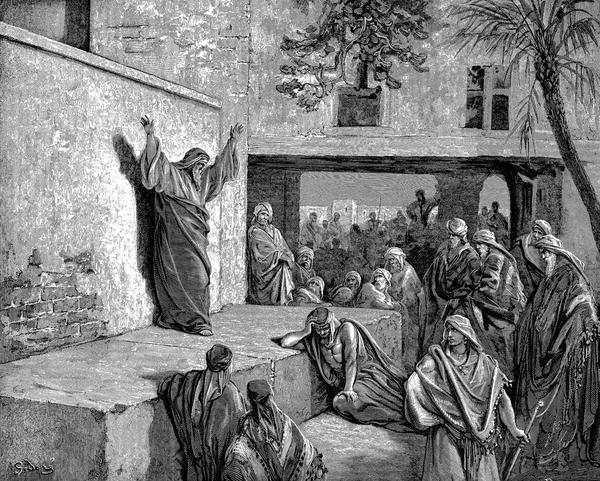
In the town of Phrygia, central Asia Minor, about the year 160AD, a man named Montanus claimed to be “seized” by the Holy Spirit. He began to receive “special” messages, “speak in tongues,” “prophecy,” and so forth. Two women “prophetesses” soon join him: Priscilla and Maximillia.
According to a Protestant/Charismatic/Emerging Church history scheme, about 300AD generally marks the point when the Church allegedly begins to enter a time of “darkness” (see part one of this series, The Charisma of the Age, an Orthodox Critique of the Charismatic Movement). The event of Montnus experiencing a ‘”new and special anointing in the Holy Spirit” transpired when the Church, according to Pentecostal-Charismatic (P/C) timeline, was still “being led by the Spirit.” Thus, for a person subscribing to a modern Charismatic philosophy of history, this incident and how Christians responded to it should bear at some weight and be thoughtfully considered.
The History of the Early Church by Eusebius, one of the first and earliest histories of Christianity, gives these details concerning Montanus and his claim to a special anointing and gift of the Spirit –
“There is said to be a certain village called Ardabau in that part of Mysia, which borders upon Phrygia. There first, they say, when Gratus was proconsul of Asia, a recent convert, Montanus by name, through his unquenchable desire for leadership, gave the adversary opportunity against him. And he became beside himself, and being suddenly in a sort of frenzy and ecstasy, he raved, and began to babble and utter strange things, prophesying in a manner contrary to the constant custom of the Church handed down by tradition from the beginning … Thus by artifice, or rather by such a system of wicked craft, the devil, devising destruction for the disobedient, and being unworthily honored by them, secretly excited and inflamed their understandings which had already become estranged from the true faith. And he stirred up besides two women, and filled them with the false spirit, so that they talked wildly and unreasonably and strangely, like the person already mentioned. And the spirit pronounced them blessed as they rejoiced and gloried in him, and puffed them up by the magnitude of his promises. But sometimes he rebuked them openly in a wise and faithful manner, that he might seem to be a reprover. But those of the Phrygians that were deceived were few in number … And the arrogant spirit taught them to revile the entire universal Church under heaven, because the spirit of false prophecy received neither honor from it nor entrance into it.”1
The Montanists also declared that they were ushering in “the age of the Holy Spirit,” and with it a supposed renewed focus on prophecy, speaking in tongues, miracles, and the other gifts of the Spirit. The modern Pentecostal/Charismatic movement has at its foundation an almost identical claim. The Montanists asserted that to reject their message was “blasphemy against the Holy Spirit.”
It is vital to highlight the canon – measuring rod – that the early Church used to discern that the Montanist experience was not consonant with the true Spirit of Christianity – The custom of the Church handed down from the beginning. Why was Montanus susceptible to this new spirit? He had arrogance – an unquenchable desire for leadership – and he allowed his own understanding … (to) become estranged from the true faith. Montanus inevitably used Scripture and a special claim of indwelling by the Holy Spirit to disregard the correcting rebuke of the the Body of Christ, the Church, in his time. With his unique “anointing” he was under no obligation to listen to “men.” The clear Christian testimony is that the spirit working in Montanus was an evil spirit and this deluding spirit deceived Montanus by “appearing as an angel of light” (cf. 2 Cor. 11:14). Not only did this false spirit deceive Montanus and his followers but it taught them to revile the true Church of our Lord Jesus Christ. In fact, it seems evident that Montanus and crew were engaging in a type of witchcraft, they were channeling dark spirits, which inevitably work some seeming signs and gave a certain degree of spiritual power.
The Montanists also prophesied exclusively in the first person, something unheard of in the Old and New Testaments. It appears that Montanus would say, “I, the Holy Spirit, say to you …;” “I, the Lord ….” Whereas the Old and New Testament prophets all spoke in this manner, “Thus says the Lord …” (cf. Act. 21:11; Is. 8:1). They also fervently proclaimed the immediate return of Christ, even professing to know the location and date. One author states, the Montanists, “Claiming to receive revelation directly from God that fulfilled and superseded the revelation given to the Apostles, Montanus emphasized direct, ecstatic, and highly emotional spiritual experiences for all believers … (they) did not claim to be messengers of God but rather claimed that God ‘possessed’ them and spoke directly through them.”2 This claim is similarly echoed in most Charismatic groups.
A common claim of novel moves, which assert that they are agents of the Holy Spirit, is they have the authority to superseded former Christian ways with their new experiences. Frequently, the claim is made that the former revelation was dead, had lost its way, was only “of men” or had become corrupted by men, and stood in need of renewal or to be abandoned completely as “dead religion.” Even Eusebius states, they “revile(d) the entire universal Church under heaven.” New spirits must first deconstruct the revealed life of Christ in the Church, and the authority given Her by Christ the Lord, and assert that it is somehow faulty and or in darkness, having become corrupted by “traditions of men.” This enables the new claims to appear more credible, and it situates the person receiving the new messages as a much needed anointed one.
I will interject here a little personal experience from my past Evangelical Charismatic days. When I first encountered the Montanist account, even before I was Orthodox, I was struck by the similarity between its experiences and claims, and my own (at that time) together with those of the modern Charismatic movement I was then part of (this was not a easy conclusion for me at the time).
In light of the firm and united, even universal, response by the Apostolic Church in its early days to the Montanist experience and teaching, the paradigm I was part of left me few options. Either I could assume that “darkness” overcame the Church much earlier and push the date of its purported corruption back before 160AD. This would provide an excuse to disregard the clear response of the Church as “dead religion,” (it is interesting to note that this is practically what Jehovah Witnesses do, they claim the Church fell into darkness also immediately after the death of the Apostles and was only restored in the 1800s, and in America no less!) or admit that my experiences and those of modern Charismatic circles – and their strong resemblance to Montanism – have been (at best) very questionable. I went with the latter option, which helped eventually bring me to Orthodoxy.
May the reader understand, I’m not attempting to, now that I’m Orthodox, find reasons in hindsight whereby to grind an ax with my former group, Evangelical Charismatic-ism. No, I began to ask many of these questions for the first time, years ago, while I was yet in the Charismatic movement. Also, I did not have a bad experience that led me to seek a way to defame my faith at that time. In fact, I was quite set on pursuing missions and ministry in the P/C movement. I asked these hard questions of myself first and foremost, as unpleasant as they were to me at the time. The same “manifestations” that I witnessed were only supported by persons and groups that had been universally condemned by the believers of the Early Church. The message was clear – the Holy Spirit does not move in such a manner at all.
Furthermore, another clear testimony of the early Church has also come down to us in a “Letter of Miltaides.” He leaves us this witnesses regarding the Montanist Charismatic movement, “But the false prophet falls into an ecstasy, in which he is without shame or fear. Beginning with purposed ignorance, he passes on, as has been stated, to involuntary madness of soul. They cannot show that one of the old or one of the new prophets was thus carried away in spirit. Neither can they boast of Agabus, or Judas, or Silas, [Acts 15:32] or the daughters of Philip, or Ammia in Philadelphia, or Quadratus, or any others not belonging to them … For the apostle thought it necessary that the prophetic gift should continue in all the Church until the final coming. But they [i.e. Montanists] cannot show it [i.e. continuity with the Universal Church]…”3
It cannot be stressed enough that the early Christians held that fellowship and continuity with the Church is a vital measuring rod of authenticity. The Montanists had no continuity with the early Christian Church. Just as the modern Charismatic movement has no continuity whatsoever. They were acting outside of the known and continuous prophetic office of the Church. The early Christian Church used Her customs and traditions – Her life in Christ – as a standard by which to discern and judge that the Montanist claim to a new experience in the Holy Spirit was, in fact, wrong, it was heresy.
Based upon the available accounts regarding Montanism, the small reconstructed picture bears remarkable similarity, most of all, to that of the Azusa Street movement, which, keep in mind, was the catalyst for every modern “Pentecostal” experience and its subsequent fruit in the Charismatic movement. I do not believe the similarities to be strained or contrived.
The early Church decisively condemned Montanism at several local councils in Asia Minor, and Bishop Zephyrius of Rome condemned it around the year 200. Although the movement lingered on for a number of years, the answer of the Early Christian Church was clear: such “charismatic experiences,” and the spirits behind the, do not have their source in God. The One Holy Apostolic Church has never known such “manifestations.”
Clearly “Charisma” is a Scriptural word that describes the gifts of the Holy Spirit to the Church (Cf. 1 Cor 12ff). The Orthodox Church believes in true charisma, and throughout Her eminent history has ever operated in the gifts of the Holy Spirit. But She also has a means by which to discern what is true charisma. This is a prerogative of the conciliar and Apostolic wisdom of the Body of Christ – test the spirits (cf. 1 John 4:1). The Church has known by the wisdom of the Holy Spirit from the very beginning that there are false spirits which give counterfeit “charismas.” The goal of these counterfeit manifestations is to deceive and to keep people from uniting to the Body of Christ.
The carefully deliberated response of the early Christian Church to Montanism and its self-professed “spiritual” gifts and power should cause pause and circumspection for the modern Christian, most of all those involved in a modern charismatic environment. Are the very recent and modern (one hundred years is not that long ago) claims to “spiritual” renewal and power be trusted? Have people put faith in a power, because undoubtedly there is a power and spirit involved in the P/C movement, without trying and testing them? Has much of modern Christendom failed to, as St. Paul admonishes, “Prove all things, and hold fast to the good” (1 Thess. 5:21)? Are signs and powers in and of themselves an end-all proof that something is of God? Or are we also to test signs and wonders, so as to see from where they have come and where they lead? “If a prophet or a dreamer of dreams arises among you and gives you a sign or a wonder, and the sign or wonder that he tells you comes to pass, and if he says, ‘Let us go after other gods,’ which you have not known, and serve them, you shall not listen to the words of that prophet …” (Deut. 13:1-3). Have we not been duly warned, by our Lord Himself, that false christs and prophets will “rise and show great signs and wonders to deceive” (cf. Matt. 24:24). Thus, power, signs, and wonders detached from the bedrock of true tradition and life in Christ as lived throughout the ages in His Church are latent dangers that will be exploited to deceive. Let us remember that the Antichrist will work great signs and wonders.
It is no critical statement to simply say, the new “spirit” introduced through the source of the Pentecostal/Charismatic movement at Azusa has a fundamentally different orientation from that of the Ancient Christian Church. It is arguably the revival not of true Christian life but rather the revival of the deceiving Montanist spirit.
Are Christians to expect a “New” outpouring of the Holy Spirit, which is intimately linked to the teaching of a “last days great revival?” Are signs and wonders de facto evidence that God is at work?
In the next article, I will undertake to test these claims.
AS A SIDE: Please understand that I’m addressing systems, and, as stated in my first article, I leave persons to God. I’m not seeking to bash the P/C movement but rather to bring forth what I believe to be very reasonable critiques of its foundations and philosophies, based upon the customs and traditions of the Orthodox Christian Church. I personally know and respect people still in the P/C movement; I’ve encountered many fervent persons who truly desire to serve God. Yet, I’m no relativist, as any who have read my blog will know. I believe that all things must be tested in and by a very objective standard, which for Christians (and even the world, though it rejects it) is the Eternal and Unchanging Revelation of Jesus Christ. Ultimately, I hope that those in the P/C movement will come out and home to the Church of our Lord, which is full of the Holy Spirit, the Orthodox Church.
1Eusebius, The History of the Church, 5.16. http://www.newadvent.org/fathers/250105.htm
2Damick, Andrew. Orthodoxy and Heterodoxy, Conciliar Media Ministries. Chesterson, IN. p. 21.
3Ibid. 5. 17.
 The Inkless Pen
Pingback: Is Christ Faithless? Examining Protestant Ecclesiology – The Inkless Pen
Pingback: A Last Days Great Revival …? – The Inkless Pen
Very good to read your articles. Thanks for writing them
LikeLike
Very interesting, thanks Father
LikeLike