Dear readers, I present to you a translation of a message from Met. Luke of Zaporozhye about the meeting of Pat. Bartholomew and Pope Leo at Iznik (Nicaea), which happened not long ago. His message is forthright and timely. I have posted a number of other messages from Met. Luke on this blog. They may be found by searching for his name via the search bar. For this article, I used an online translator (Yandex) and then compared it to the original and made adjustments accordingly. This expedites my ability to get this vital message out in English. The original article in Russian may be found here. May we hold fast to the Truth of our Lord Jesus Christ.
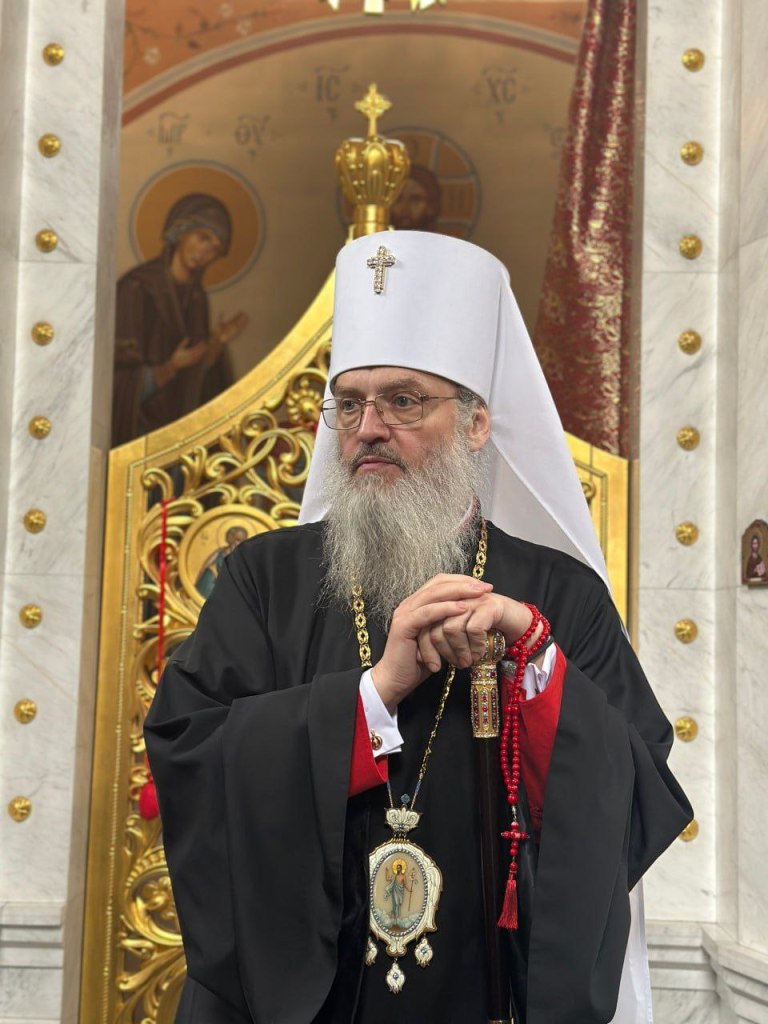
Christ is in our midst, my dear readers!
Iznik and the Predators of Humanity: What “Unity” Conceals.
What happened in Iznik (formerly Nicaea), the city where the Nicene Creed was formed, where the Fathers of the [1st] Council courageously cut off any distortion of the truth, should have been a moment of awe and responsibility. Any theological event here must breathe the spirit of the Nicene-Constantiopolitan Creed, not only in its words, but also in its unyielding strict faithfulness in matters of Truth. However, it is here that a bitter irony emerges: the memory of the Council that established dogmatic truth is used as an excuse to blur dogmatic boundaries, and the word “unity” turns into rhetoric used to cover over processes that have almost nothing to do with the Truth. In light of this, the words of the Apostle Paul about “scoundrels” (1 Tim. 1:10) are especially acute today — those who, using spiritual authority, soft words and plausible pretexts, lead people where Christ did not command – to spiritual slaughter. This raises several questions.
- Why does Patriarch Bartholomew seek an alliance with Roman Catholics, but does nothing for unity in the Orthodox world? This is the main and most painful question. If a person sincerely supports the unity of the Church, it is logical that the first and urgent step is to heal the intra-Orthodox schism, which today has reached a level that has not been seen since the time of the Great Schism. When you look at what is happening, it becomes obvious that the real efforts are not aimed at restoring the inner Orthodox world. First of all, the absence of any step towards the resumption of Eucharistic unity between the Local Churches is striking, without which any talk about church peace becomes an empty sound. But even this is not enough — we do not see the slightest sign of repentance for those unilateral and openly anti-canonical actions that gave rise to the current crisis. Instead of trying to correct the mistake, acknowledge their responsibility and return to conciliarity, there is a hardening of the previous line taken. As a result, instead of a humble search for unity, we are witnessing the continuation of the previous policy of “first without equals,” interference and unilateral decisions that only deepen wounds instead of healing them. So, step by step, it seems that the goal is not peace at all, but rather the establishment of one’s own power under the guise of concern for “unity.” Against this background, talking about “unity with Roman Catholics” while ignoring one’s divided home looks not like a desire for truth but as a political project where “unity” becomes a tool, not a virtue. The Holy Fathers repeatedly warned that a destroyer of the inner peace of the Church can never be a peacemaker from the outside. Peace acquired at the price of manipulation is not a peace, but a trap; exactly what human predators exploit.
- Why was there not (rather) an attempt to gather the entire Orthodox family? If the father of a family begins to seek reconciliation with others before reconciling with his own children, this would raise questions. Furthermore, within the ecclesiastical realm, it is also a canonical violation. The canonical principle of conciliarity is not an abstraction, but a practical law of the life of the Church: no Local Church has the right to act as “first without equal,” because such behavior destroys the balance and fraternal relations between Churches. An urgent conclusion follows from this: issues concerning church unity and order must have a conciliar resolution, formed in the presence and with the consent of the Local [Orthodox] Churches, and not by the will of a single center. Accordingly, it is unacceptable to elevate the private opinion — even of an authoritative hierarch — above the opinion of the Church of Christ in Her conciliar expression; when personal initiative is placed above conciliarity, this is no longer a pastoral concern, but an abuse of power. Therefore, any unilateral steps taken outside the conciliar consent are both canonically unlawful and spiritually harmful to the Church. When the Patriarch of Constantinople acts inappropriately, bypassing everyone else, and then covers it up with “concern for universal unity,” this is what the holy fathers called a mask of piety, which hides the will to power, not the will to truth. Such a violation of the canons under a plausible pretext is what Christ said: “Beware of false prophets who come to you in sheep’s clothing…”. This is exactly how scoundrels act: soft words leading not to peace, but to unia.
- Why is unity with Roman Catholics placed above loyalty to [authentic] Orthodox Catholicism? Roman Catholics are not enemies, but our theological differences have not disappeared. We have different ecclesiologies, different ideas about primacy, grace, and the Church as such. The Nicene Creed is only the foundation, but not the entire edifice of theology. Celebrating “unity” when there is no such unity is a form of spiritual deception. The whole history of the Church testifies that there is no unity outside of the Truth. But today it is forgotten. And the terrifying thing is that it is forgotten by those who should be the foremost guardians of this understanding.
- What are the dangers of such initiatives? They lead the flock of Christ to destruction. When, at the moment of the greatest internal crisis, with the most acute schism within Orthodoxy, demonstrative steps are being taken towards Roman Catholics, this is no longer theology, but a reorientation in a different direction. This is an attempt to make it clear to the world: “True unity is with Rome, not with the Orthodox brothers.” Thus, a de facto unia is born — not signed on paper, but operating in symbols, joint events, common statements and theological drift. This is exactly what the spiritual “mouth” is about, which the apostle Paul warns, calling them scoundrels: at first they gain the trust of ordinary people not by force, but by a smile, accessibility and seeming care, in order to lead them no longer according to Christ, but their own will. Having established a bond of trust, they are able to substitute clear canons for diplomacy. Instead of a clear canonical order, there are soft formulas, verbal juggling, compromises, and appeals to the “spirit of the times,” which seem flexible and peacemaking but actually blur the canonical foundation of the Church. This substitution is accompanied by another device: they lull vigilance with beautiful words and solemn phrases, so that the attention of pastors and people is distracted from the essence — dogmatic and canonical fidelity — by spectacular images and loud declarations. This is how predators act, not by attacking, but by charm. And as a result, the most dangerous thing happens: external unity is elevated above the inner truth — joint photographs, joint events and simulacra of community are more important than genuine Eucharistic and dogmatic unity. Thus, step by step, the external appearance obscures the internal reality: the flock remains at a complete loss, and canonical conciliarity and truth are replaced by power and diplomacy. This is exactly what the human predators do in sheep’s clothing.
- What is to be done? The only answer is to return to the spirit of the Nicene—Constantinopolitan confession, to the inner sobriety and strict faithfulness that guided the fathers of the Council. It was they who left us, not only the formula of faith, but also the image of the ordering of church life, where Truth prevails, and not political conjuncture. Therefore, the right path today is completely different from the one we are observing. First of all, genuine repentance is needed for the introduction of schism into Orthodoxy, for those unilateral actions that destroyed conciliarity and gave rise to today’s wounds. As long as there is no repentance, everything else is mere rhetoric. Following this, a conciliar discussion of the problems with all the Local Churches is required. Only a common Meal, common prayer, and common conversation can restore lost trust and restore church order, rather than the diplomatic initiatives of a single see. The next step should be the restoration of Eucharistic unity within Orthodoxy itself, because without it, any external “hugs” and gestures of goodwill towards other faiths turn into a false signal. You can’t talk about unity with outsiders when your own family is divided, and the wounds inside are still bleeding. Only on this solid foundation (of Orthodoxy unity) can a common Orthodox witness to the world be heard, based not on diplomacy and political interests, but on fidelity to Truth and unchangeable Tradition. Then the voice of the Church of Christ will be heard by the world as clearly as it sounded through the mouths of the holy Fathers in Nicaea. This is how the great Fathers would have celebrated the memory of the Council — and this is how their heirs should celebrate today if they strive to be the guardians of the Truth rather than its managers.
What happened in Iznik is not just a theological platform or a cultural event. It is a symbolic gesture that shows the direction chosen by a certain church group: not towards [authentic]Orthodox Catholicity, but towards a new union. And it is here that the words of the Apostle Paul come to life with special force: “The law is laid down … for murderers, fornicators, sodomites … extortioners of mankind…” (1 Tim. 1:10). Predators of humanity are not only criminals of the past. These are those who steal the freedom of the church’s consciousness, substitute diplomacy for truth, and lead people into a spiritual trap using the name of peace. Today, sobriety, prayer, and the ability to discern spirits are required of every Orthodox. The times are not simple. And not every “unity” is from the Holy Spirit.
 The Inkless Pen
Thank you for translating and sharing this message from Metropolitan Luke. What strikes me most is not the sharpness of his language, but the clarity of his ecclesiology. His concern is not political, nor anti-Catholic, but profoundly Orthodox: unity cannot be pursued outwardly while conciliarity and Eucharistic communion are broken inwardly.
The choice of Nicaea/Iznik is not incidental. It is precisely there that the Fathers showed us how unity is guarded — through repentance, conciliar discernment, and faithfulness to truth, not through unilateral action or diplomatic symbolism. To invoke Nicaea while bypassing conciliar process risks turning the memory of the Councils into a stage rather than a standard.
Metropolitan Luke’s warning about “unity” becoming a tool rather than a virtue deserves careful attention. The Church has always taught that there is no peace apart from truth, and no unity apart from shared confession and Eucharistic communion. External gestures without internal healing do not strengthen the Church; they confuse the faithful and deepen wounds.
This is not a call to isolation or hostility, but to sobriety. The Fathers never opposed dialogue — they opposed false peace. If we truly desire unity, the first step must be repentance for actions that fractured Orthodoxy, followed by a genuinely conciliar process involving all the Local Churches. Anything else risks repeating the errors the Councils were convened to prevent.
In times like these, discernment is an act of love. May God grant us humility, clarity, and faithfulness to the Truth entrusted to the Church.
LikeLike
Father bless
Thank your father Zachariah for your translation of that letter. In our family we are definitely feeling the weight of some of the things mentioned in that letter. The truth is especially in the west most of us are converts to the faith so knowing how to properly navigate our thoughts and our feelings within an orthodox mindset can be very hard to know how to discern! I am nearly 50 years old and I have been a part of so many different churches in my lifetime and once we found orthodoxy and learned that it was actually the truth for the first time in my life I felt like my feet were actually firmly planted on solid ground and I could actually begin to heal and grow in a proper and true way! And now I feel as though I have been partially uprooted! In my own personal family this has caused A few serious disagreements and extreme confusion on how we are to navigate our lives within our local parish community. It has also caused a lack of trust for the leadership of the church in America. In your opinion Father what would be your best advice for how we should move forward within our own local Parish communities!? We have only been in the church for almost 4 years now and I don’t trust in my ability to discern these things so I don’t feel that it is my duty to run around my parish and sound the alarm if you will. The truth is I love our church family. My wife and I are deeply rooted in our church and have both taken on personal rolls within the church body (maintenance and cleaning team). We have 5 God children and are both in the choir. Should we not just continue to press forward in our church whether we are OCA, ROCOR, Serbian, Greek? In the nig picture do any of those distinctions over jurisdictions matter. Or is the church the church? Any advice would be deeply appreciated. Thank you Father
LikeLike