“Bodily exercise is profitable for a little, but piety is profitable for all things” St. Paul (1 Tim. 4:8).
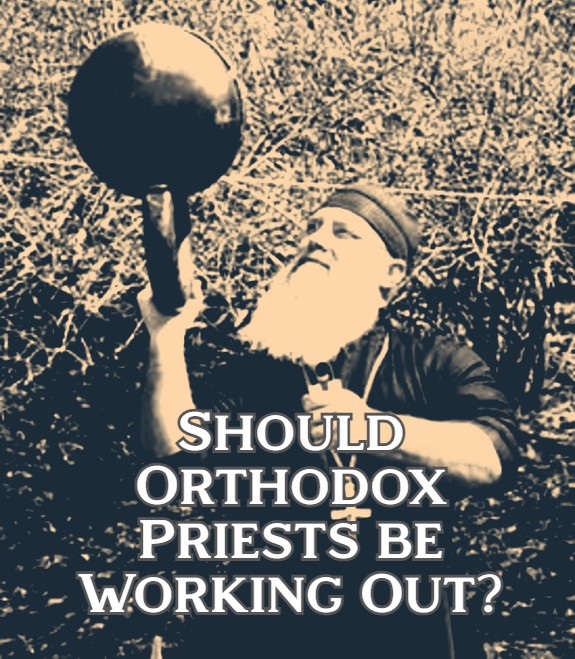
Should an Orthodox priest be working out? Is it possible that in doing so he would somehow detract from the very spiritual nature of being a priest? The question may be expanded, should Orthodox Christians in general be exercising or “working out”?
My simple answer is yes. There you have it. You could just stop reading here or you may continue to read and I will explain why I have come to that conclusion.
For those continuing to read, here we go.
True Christianity views all things in their proper place and order. The body is an integral part of the human person. In its current state, it is passing away but the bodily resurrection is vital to Christianity. A goal of the Christian life is the right relationship to everything of the created order. This includes the body. The body is not evil or bad because it is created by God. When the totality of Adam (humanity) was completed by the Lord, it was called “very good.” Due to sin the human person has become corrupted. The total human person needs to be healed and rightly orientated. St. Theophan the Recluse delineates three “lives” of the human person in his work, The Spiritual life and How to be Attuned to it: 1) the life of the body 2) the life of the soul 3) the life of the spirit. These three aspects must energize in their right order and function, and by doing so harmonize with each other. When this happens a person begins to live according to the fullness of his God created humanity and thereby may enter into communion with God. Although they may be addressed each in a particular way, they are part of the totality of what it means to be human.
The life of the body is the primary interface by which we empirically encounter the created and sensual (that is of the sense) world around us. When a person becomes dominated strictly by what the bodily senses perceive and desire, then this state is called “of the flesh” or “carnal.” This cultivates a state of spiritual blindness. A foundational virtue is that of temperance also called chastity or self-control. This virtue, by God’s grace, aids the body in the correct relationship with everything in the material world. It aids the Christian person to remain in control of himself. Matter is not evil. But a disoriented person will abuse matter and use it for evil. Before humanity stands the ability to either rightly use or abuse the created world.
Several years into being a parish priest, in my late thirties, I became quite sick. I’m not going to give much background here as to the why and events that fomented it because I plan to cover it in my series entitled “The Diary of an American Priest.” Suffice for this article to state that I was in and out of hospitals and doctors’ offices. I’m almost 5′ 11” in height and I dwindled in weight to about 135lbs. It was a difficult time. It was a great exertion of energy just to do basic things, and moreover, try to keep up as a priest. I had very little help from establishment medicine. Yet, in one of my tours in the ER, a nurse told me, “You need to start exercising.”
Humm? I used to do that in my twenties. Nothing major, but I did enjoy it. I stopped a little before I went to seminary. Sometimes in the Orthodox world, there seems to float around an idea that exercise is just vain. I can’t say that it is explicitly expressed. But it seems implied in some attitudes and statements when the subject comes up. It’s not wholesale, but I have encountered it. Maybe I permitted it to influence me a little. You don’t want to be vain as a priest, after all, wait, is it vain not to want to be vain? Vanity, vanity, all is vanity. Ultimately, it was my choice. I stopped exercising. I had spiritual things to focus on.
Yet, in my many episodes of lying in utter exhaustion in bed, I realized that the proper function of the body is a real blessing. Interestingly enough, the words of that random nurse would just bounce in my head at times, “You need to exercise!” Wherever she is, whoever she may be, thanks for telling that to me.
It was not solely exercise; I had to implement some other things too, such as dietary changes. But exercise helped a lot, I rank it top of the list. At first, it was a chore, and it took a lot of motivation to be committed. I started simple, just basic calisthenics– push-ups, pull-ups, sit-ups, chair dips, and such. I could barely do a few of them, but those few began to expand. After a little while, I found the most basic bench possible (it was cheap and all I could afford at the time) and got a standard barbell with some miscellaneous weights. And on I went. I started hiking again, too.
By God’s grace, my body began getting better. It was very clear to me that the state of my body was having a massive influence on the total state of my person. Energy levels rose, as did my spirit. It was evident that exercise was playing an important role in my physical recovery. I haven’t stopped exercising since then.
I also realized that I was part of a “profession” that was generally not too healthy. Many priests suffer from a variety of ailments. Although a priest must stand up for most Orthodox services, and there are limited movements in the services, nonetheless, the vocation can become sedentary, somewhat akin to an office job. Even when on visitations, the priest sits in his car and then sits at whatever place the visit may take place. By secular standards, the vocation of being a priest would be considered a “high-stress” profession. This compounds things too. Many priests proverbially “burn the candle at both ends” which can increase burnout, both physically and mentally.
Sadly, America is plagued with terribly high rates of chronic illnesses and priests don’t magically escape this environmental influence. Due to some of the issues I mentioned above, it seems they can become easy prey to it. This is a real tragedy. I don’t have any group statistics, and I’m not sure that they even exist, but my limited impressions tell me that the priestly vocation follows the high chronic illness patterns of America. I would not be surprised if its rates were even higher.
The body, following a similar principle as the spirit, will respond to the environment and disciplines, or the lack thereof, that are imposed upon it. The spiritual life does not develop on its own, it requires cooperation and effort from the person perusing it. This is why a “prayer rule” or better, disciple, is important in Christian life. A certain discipline and exercise of the body is also of great profit. In fact, I believe that the Lord implanted this principle in the body because it is easier for people to observe, and properly observed, it may also be applied to spiritual things. This is clearly reflected in the Christian use of the word “asceticism” for the exercising of the spiritual life (see my article Ascetic Strength where I explore this in more detail) because this word originally related to exercising the body. The spiritual aspect of man must be exercised or it will never show growth and advancement in the things of the Lord. Without spiritual exercise, the spirit becomes unhealthy and weak. Of course, this can only be fully achieved by the grace of God.
The body, in a similar manner, will either bring forth health and strength or illness and weakness depending on how it is exercised, what it is fed, and so forth. The Christian reality understands that the body in its current state is passing away, and thus, in the hierarchy of being and importance, the spirit should always take the lead. But Christianity rejects both the Gnostic deprecation of the body as something to be despised and the Hellenic extreme of over-idolization of the body as the end-all of existence. Ultimately, the Lord God is the master of all things, and even the welfare of the body flows from Him because He created it, and it also may become a “temple of the Holy Spirit” (cf. 1 Cor. 6:19). Moreover, Orthodox Christian prayers are frequently asking for “health of body and soul.”
The body is not only vital for human life but is also an essential aid in the spiritual life. When my body was in turmoil, it made spiritual activities very difficult. When it began to heal, the spiritual activities began to move with greater ease. The connection was very clear to me through this experience.
In Orthodox Christianity, there are some dramatic examples of asceticism, most of all in the lives of some monastic saints. Asceticism is indisputably for all Christians, yet its application will vary according to vocation and situation. As a married man and a parish priest, I realized I have a duty to strive to function as best as I can. When I do, I am utilizing the created gifts of the Lord to be a good steward of what has been entrusted to me. In this article, I’m not trying to address monastics; I’m addressing Christians living in the world and facing the many complexities of it. Through my experience with a severe illness, I realized that I was mismanaging the totality of my being to the detriment of myself and those around me. Nowhere does the Lord ask us to do that, and there is nothing spiritual about it. Although the Lord can use such experiences to instruct and teach, sometimes bodily ailment comes upon us despite all precautions. Yet, being weak, sickly, and unhealthy is by no means a de facto spiritually beneficial state, just as being strictly obsessed with bodily health is not a spiritual state. There is a proper balance.
Further, a disciplined schedule of exercise helped to develop an understanding of general ascetic principles in my life. Exercise provides a very real and tangible context for ascetic principles. This was very helpful for me. If the body responds to such and such discipline, how much more the spirit! In a proper and balanced place, exercise challenges the fallen laziness of the body. I think that sometimes we, as humans, can simply be lazy and then spiritualize our laziness to avoid bodily exercise. Some justify the neglect of exercise under the pretext that it is vain and not spiritual. I think that’s also just a lame cop-out. If you don’t want to exercise, then don’t. But don’t project it as somehow “more spiritual,” because it’s not. Even a moderate exercise routine affords many benefits directly applicable to spiritual life. Discipline, dedication, pursuit of goals, growth, understanding one’s weaknesses and strengths, and so on. For a lot of men, it can aid in positively directing some of the masculine energy that gets either bottled up or dissipated into hopelessness in the modern age. It is a good thing for a man to be strong according to his ability, most of all a man who is, or desires to be, a married man with a family. It is a beneficial and healthy challenge for men to rise up and cultivate strength, even physical strength, within its proper boundaries. This is healthy within the God-given place of man as a defender and Christ-emulating leader of his family. This is very important in a modern world that seeks to emasculate what it means to be a man. Women have their God-created strengths that are unique to them. Exercise is beneficial for both and will be manifested according to the unique diversity of male and female as created by God.
Our times are very different from times before; sedentary lifestyles are now predominant, especially in America. Life 120 years ago imposed activity and movement on people. Movement is vital to the body. In our times, people have to seek out ways to keep the body moving positively. This is where the importance of exercise can come in, or so I believe. Because of these novel environmental factors and their detrimental tolls on the totality of human health, exercise has become more of a necessity than it would have been over a century ago. We have to deal with the times in which we live and find the balance for Christian living. The body in its current fallen state is passing away, but is nonetheless an equally vital component of who I am as a person. In exercising, I remember that it is for a passing benefit, just like eating, drinking, sleeping, working, and so on. Exercise has a God-given limited productivity, but the pursuit of everlasting things is what lasts for eternity. Yet, I still need this body to pursue those things. And so, “Whatever you do, be doing all things for the glory of God” (cf. 1 Cor. 10:31).
This addendum on the topic of prostrations was added the day after I penned this article.
Prostrations are not “exercise,” they are bodily participation and offering of prayer. Indisputably, they may afford certain physical benefits akin to exercise, but if you are doing them for “exercise,” I believe that is starting from the wrong motive. Moreover, most people are not doing them in such a quantity that would even yield the benefits of “exercise.” Yet, the goal of prostrations is not to be “fit,” but rather an ascetic aid in focusing the body, while humbling it, on the prayers being offered. Let’s not try to conflate these things. Exercise is for the good stewardship of my bodily health, which does carry a spiritual reality; prostrations are for the sharpening of my spiritual being, which does share a physical manifestation. Prostrations are ultimately part of prayer life, not exercise.
 The Inkless Pen
Father bless.
Fr. Lynch,
Thank you for this. Are you familiar with St. Nektarios’ “On exercise?” He explains further on the “proper balance” of the two. See the below.
There seems to be a belief among not a few Orthodox [clergy and laity alike] that exercise and the physical maintenance of the body is not important on the one hand, an attitude to “spiritualize our laziness to avoid bodily exercise” as you said, and on the other that ‘exercise’ is an activity that can be pursued [by clergy and laity alike] as in competitive body building or weight lifting. How is this latter pursuit not “vanity?” Is a “proper balance” in this choice to compete possible? Any clarification or explanation would be appreciated. Your thoughts.
Doxa to Theo, John D.
Father bless.
On Exercise – St. Nektarios of Aegina Orthodox Wisdom https://www.youtube.com/watch?v=-l6Ar7pHwAA
Transcript @ “On Exercise” by St. Nektarios of Aegina
An excerpt from For Mind and Heart: St. Nektarios As Teacher Translated by Fr. John Palmer
https://www.orthodoxethos.com/post/on-exercise-by-st-nektarios-of-aegina
LikeLike
Yes, I’m familiar with St. Nektarios words on Exercise and drew a little from them as inspiration for my article.
LikeLike
That is a good question about vanity, although I’ll note that I never explicitly mentioned specific workout forms, such a s body building. Certainly, some forms of exercise that are focused almost exclusively on aesthetics and even inflict substantial long-term harm to the body to achieve it may be seen as missing the mark. Exercise is for strength and cultivation of health for the body. Humanity can turn almost anything into vanity. The Pharisees are rebuked for praying on the street corners and giving alms to be seen, this is vanity, although both prayer and alms are very good things. The writings of the saints even warn about taking pride, turning to vanity, fasting. There are lots of warnings in the writings of the saints against “prelest,” but no one stops prayer, fasting, or alms giving because there is the potential to turn them to our vanity. This is where guarding of the heart comes in. Thus, a similar warning is in place for physical exercise, as with spiritual. And as with the spiritual no one stops the endeavors but keeps on guard, so with the physical. These are my brief thoughts on the issue. Since it is physical, I’m not against competitions for strength.
LikeLike
Father Bless !! This is an encouragement. Discipline is essential to an Orthodox life and it makes sense that bodily discipline is a part of that. Since leaving Colorado and all of its built-in hiking opportunities, I have slacked off quite a bit. Your story is motivating. Thank you. Pray for me.
LikeLike
Fr. Zacharias, your blessing.
I enjoyed your article on “You may not, not kiss the Icon”.
I have to offer some disagreements on what you said here, particularly your addendum on prostrations:
There’s a modern movement in Orthodoxy to encourage modern exercises (Deadlifting, Powerlifting, CrossFit, Running, Rowing, Biking), but noticeably not the same fervor in recommending prostrations. Whether we call prostrations exercise or not makes no difference… it is good for the body in the same way physical exercise is. This is not impious to admit, because this is something all of our saints knew and talked about:
“The pitiable worldly people do not know how beneficial prostrations are — not only for the health of the soul, but also for that of the body. They are good for arthritis; they get rid of flaccidness, they also eliminate unnatural looking bellies; they impart serenity, and they contribute to a certain manliness.” — St. Paisios the Athonite
You mention prostrations only in a footnote, cautioning against appreciating their bodily benefits, while the main article celebrates other forms of exercise. I know you have good intentions Father, but I think this is stigmatizing prostrations unnecessarily. If St. Paisios says that prostrations are good and beneficial (especially to bodily health), what is the purpose of relegating them to an addendum where they’re only stigmatized?
I noticed in your comments you mentioned the Pharisees praying on street corners as a caution about vanity in exercise. I’m curious about this analogy when applied to prostrations, since prostrations are typically done privately in one’s prayer corner, not publicly “to be seen by men.” You also noted in your comments that we don’t stop doing good things like prayer and fasting just because they might become occasions for pride – we guard our hearts instead. This is an excellent point, and I think this needs to be our understanding around prostrations. Rather than discouraging appreciation of the bodily benefits of prostrations, we could encourage people to do them with proper mindset and guarding of our hearts, as the saints taught.
Your statement that “most people are not doing them in such a quantity that would even yield the benefits of ‘exercise'” is in my opinion, not what our saints say, and is not what my own personal experience says. Most people in our times are especially sedentary. Doing 33, 60, 100 prostrations a day is absolutely going to have a beneficial effect on them, and they can always do more formal exercise afterward.
Also, prostrations are very accessible in that they don’t require one to dress up in workout clothes, buy certain equipment, allocate a certain time to them, go to a certain place to do them, etc. In our times where people can’t motivate themselves to do any of their prayer rule or formal exercise, anything that eases the barrier to entry is potentially useful.
If one has only 15 minutes, the premise of doing that which benefits the soul and body should absolutely be a big focus. It is not though unfortunately, and this is largely in part to prostrations being unnecessarily stigmatized.
The truth is that the tradition teaches us to take care of our body as you say. Prostrations can help with that, but we unfortunately conclude: “I need to get in better shape, but wanting to do prostrations because I’m out of shape – being motivated by my physical condition – that’s an impious sentiment, so I shouldn’t do them”. In actuality we can say “I need to get in better shape, so I will do prostrations, but I will do them sincerely as a form of prayer too. And through the pursuit of health of body, I can also attain health of soul, as St. Paisios the Athonite tells me”.
As for exercising, even though it isn’t formal prayer, it too, as things for an Orthodox Christian, should be done for God: “So whether you eat or drink or whatever you do, do it all for the glory of God.” — 1 Corinthians 10:31
So it’s not as in a completely separate category from prostrations as we think.
I personally exercise too, but it seems to me that our saints who did hundreds of prostrations a day are in far better shape than even the majority of people who practically live in the gym are (including me).
In conclusion, people exercising is totally fine and good, but prostrations should be encouraged first as being superior, and at the very least we shouldn’t stigmatize doing prostrations. Whether we consider them exercise is more or less irrelevant. They are a physical movement, that can positively contribute to our bodily health, as St. Paisios states.
In our times of lukewarmness, it is common for every act of piety to be considered Pharisaical and to be “praying on the street corner for all to see”, but this sentiment can and is invoked to level and discourage any and all acts of piety that our saints call us to.
LikeLike
Dear Silouan, Thank you for your thoughts.
Thankfully there is a lot of material on prostrations, as you have alluded to in your comment. Unfortunately, I think you are misconstruing my points. My article was not about prostrations and never had the objective of stigmatizing them; thus, it is a misnomer to suggest that. I never discouraged performing prostrations, not sure where you got that. I never opposed prostration vs. working out. The objective of the article was not to discourage prostrations, neither was the objective to be a discourse on prostrations. Absolutely, do them and they will have a physical benefit. I think you are making a bit more of the brief end note then I intended, but I appreciate some of your points. Although, I’m not sure how you tied prostrations to being Pharisaical, as I never made that connection in the article. I also think you are taking it in a more rigidly categorical manner than I intended. Obviously. there is very real physical benefit from prostrations, it is what could be qualified as a full body workout. I touch on this very point in my end note. Yet, my basic point was not to diminish this, but to highlight that the primary goal of prostrations is a focused act of prayer. When I do them, it is ultimately to this end and the physical benefits are a side plus. I’m touching on the telos of an action. This meshes with the basic premise of St. Paisios quote that you provided, moving the body is good but prayer is the ultimate good.
Similarly, fasting is not dieting. Although fasting may have aspects of dieting. The goal of dieting is focused on a merely physical result (which may be beneficial), fasting is coupled with prayer and is focused on the training of the inner man. Here too there can be physical benefits from fasting and a change of food intake. This also may be presented to encourage fasting. But the ultimate telos of a fast is not dieting; similarly, the ultimate telos of prostrations is not exercise. Or course, utilize the side benefits too: there is exercise in prostrations, but ultimately prostrations are not exercise; there is dieting benefits in fasting but ultimately fasting is not dieting.
The goal of the article was to encourage people to do exercise, that simple. It is not a discourse on prostrations. Maybe you assume it should have been about prostrations? I’m assuming that Orthodox people are being encouraged to do prostrations from numerous other sources. God bless.
LikeLike
Father, thank you very much for taking the time to respond and to clarify your intention. I’m grateful for your work and for the emphasis you place on prostrations and asceticism.
My earlier comment was not meant as a judgment on your intention, which I cannot know, but only as a reflection on how the wording of the addendum naturally comes across. As it is written, the statements about prostrations “not being exercise” can seem, without reference to your intention, to sit at odds with the way St. Paisios speaks of their bodily benefit, and to downplay or even discourage attention to that aspect.
Since a reader may not know your intention when encountering these comments, Father, I was simply responding to what is on the page. Your follow‑up here makes it clear that you do acknowledge the real physical benefit of prostrations and that you do not wish to discourage them, but rather to keep their primary character as prayer and repentance.
I appreciate that very much, and I believe we are in agreement. My only humble suggestion would be that, if you deem it pastorally helpful, the written addendum might be adjusted slightly so that this balance comes through as clearly as you have expressed it here, perhaps even with a simple positive line in the main text about prostrations as a prime example of embodied prayer that also benefits the body, so that the wording matches what you intended to communicate.
LikeLike