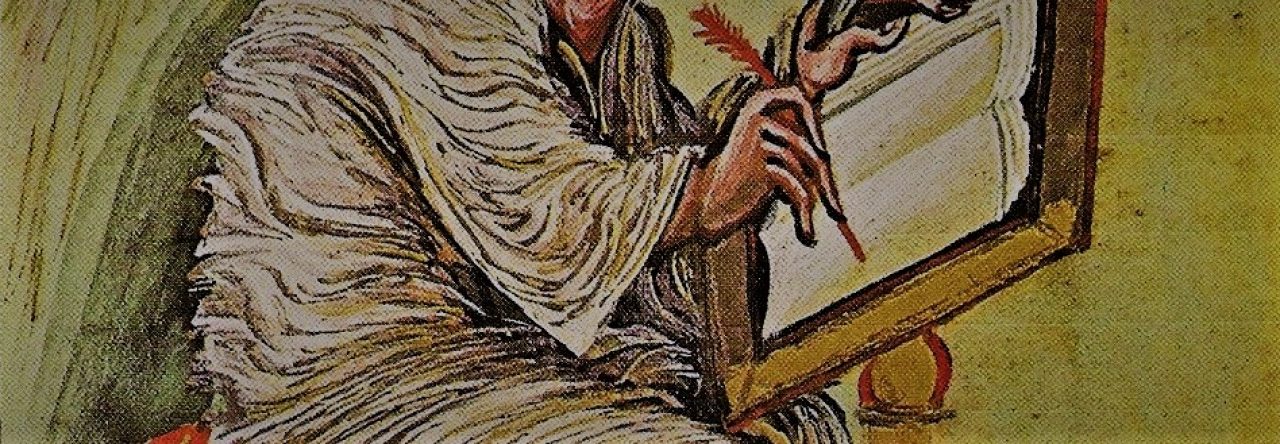
“The Kingdom of heaven is like a grain of mustard seed, which a man took and sowed in his field,” Matthew 13:31.
Creation is a book of teaching. One of many given by God. “It is clear that whoever reads the natural without knowing the spiritual content and significance of what he reads, reads death, sees death, appropriates death. Also, whoever considers visible nature as the only reality and not as a riddle on the mirror of the spirit, does not know more than a child who may recognize letters but is far from understanding written words,” proclaims St. Nikolai Velimirovich (The Universe as Symbol and Sign, pg 11).
He teaches, “It is written in Genesis: In the beginning God created the heaven and the earth (Gen. 1:1). According to the Fathers of the Church, heaven is meant as the kingdom of spiritual realities, the bodiless and the invisible. The earth is meant as the universal amount of the body and visible symbols of those realities. That is to say, the earth or the universe generally, is nothing but a symbolic picture of heaven” (Ibid, pg. 15).
Although creation is subject to futility due to humanity’s fall, it will be delivered from the bondage of decay into the freedom of the children of God; until then, it groans under the burden of mankind’s rebellion against God (cf. Romans 8:20-23). It was not created for futility. That’s not its nature in the least.
The parabolic nature of creation is part of its God-instilled logoi. When our Lord Jesus walked the earth, he drew many of his teachings from the parables of creation. “Learn this parable from the fig tree,” he clearly taught (cf. Matt. 24:32).
In the modern mindset, nature is utilitarian, not parabolic or symbolic. The Darwinian myth of our age sees in nature only death, survival, and instincts. These are there, but they are not the total picture by a long shot. As moderns, we observe through the narrow keyhole of futility, to which creation was subjected, and then assume that this futility is the totality of reality. The apparent brutality of futility is not the nature of creation but the effect of sin and death. We certainly observe it, but we should do so with sorrow because creation is in such a state due to humanity’s (our) rebellion.
Futility does not impede the parable of creation, because it is part of its divinely created logoi, while futility is not. Authentic science views in total, not in compartments. The reduction of “science” to the compartment of strict physical observation, under the influence of futility, is the death of true science. Such is also the death of the spiritual life and understanding. Speaking of the vocation of a true Christian and the exact contemplation of the truth in all things, St. Dimitru says (quoting at first St. Maximus), “’Going on from here we shall bring to light many and varying logoi of truth by wise contemplation of perceptible things and of intelligent beings.’ In everything that we do or understand, we now have a vision of the whole, of the relationship of our deed or thing with the universal order,” (Orthodox Spiritually, pg. 197).
Today, much of what labels itself as “Christian” is blind to the knowledge of icon in the created order. Is this surprising? Most modern forms of “Christianity” are iconoclastic in their vision. Particularly, Protestantism is a utilitarian spirituality, if those two words can be linked in that way. It is the mother of the secular utilitarian mindset. But I digress.
A vocation of the true Christian is to learn to read the book of God’s revelation in His Creation. The saints frequently walk this path of parable. And so must we.
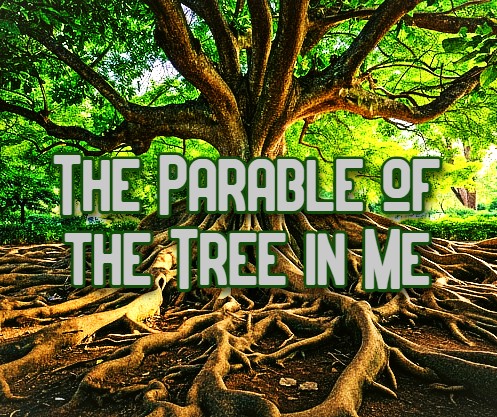
“For a clearer picture of the Christian journey let us adopt the method resorted to by the fathers of the Church, and draw an analogy. When we see a centuries-old tree with its branches reaching to the clouds, we know that its roots, deep in the earth, must be powerful enough to support the whole. If the roots did not go down into the bowels of the earth – perhaps as far down as the tree is high – and if they were not as strong and widespread as the part we see, they could not feed the tree. They could not support it – a slight wind and the tree would fall. We can observe something similar in the spiritual life of man,” writes St. Sophrony (His Life is Mine, pg 85-86).
The tree is a symbol of man in the spiritual life; the Christian is a spiritual tree. “Blessed is the man that has not walked in the counsel of the ungodly, nor stood in the way of sinners, nor sat in the seat of the pestilent. But his will is rather in the law of the Lord, and in his law will he meditate day and night. And he shall be like a tree planted by streams of waters, which bring forth its fruit in its season, and its leaf shall not fall,” (Ps. 1:1-3).
St. Nikolai propounds, “A tree must be rooted in the earth in order that it may grow. It is a symbol of the soul, which must be rooted in the spiritual, heavenly world, which is its earth, its soil. In order to flourish a tree must be watered. Even so, the human soul must be watered by the grace of the Holy Spirit in order to be healthy and strong. St. Anthony the Egyptian says, ‘As trees cannot grow without water, just so the soul cannot grow if it does not feed on heavenly sweetness. Only those souls are growing, which have received the Holy Spirit and which are filled with heavenly sweetness,” (The Universe as Symbols and Signs, pg. 26).
“Everyone who drinks of this water will be thirsty again! But whoever drinks of the water that I will give him will never be thirsty again. Not only this, the water I give him will become in him a well of water springing up to eternal life,” proclaims the Lord (John 4:13-14). And again, “If anyone is thirsty, let him drink! From within whoever believes in Me, as the Scripture has said, will flow rivers of living water,” (John 7:37-38)!
“Blessed are those who hunger and thirst after righteousness, for they shall be filled,” (Matt. 5:6)!
The branches of a tree are roots in the sky, and the roots are branches in the earth. It feeds simultaneously both in the bright heights and the dark earth. It moves in the seen and the unseen. It is nourished by both surface and deep waters; it is illuminated by the light of the sun. It dwells in harmony between two planes, the earth and the heavens. The tree receives the energy-light of the sun and makes it its life. So it is with a person growing in the spiritual life. The waters are of the Spirit, the light is the Divine uncreated energies of the Holy Trinity.
“A tree must be exposed to light and warmth of the sun in order to flourish and bear fruit – a symbol again. For the soul too must be lightened and warmed by God, the Sun of eternal righteousness. Only under such conditions can the soul, exposed to the light and warmth of the Living and Life-giving God, live, grow, and bring forth fruit,” (St. Nikolai, The Universe as Symbols and Signs, pg. 26).
A believer becomes a true tree when he receives and cultivates the seed of the Kingdom within himself. The symbolic mustard seed is “Indeed smaller than all seeds, but when it is grown, it is the biggest of shrubs and becomes a tree, so that the birds of the air can come and find shelter in its branches” (Matt. 13:32). And thus, “Neither will people say, ‘Look, here’ of ‘Look, there!’ for behold the Kingdom of God is within you,” (Luke 17:21).
“You too, O reader, must be as a grain of mustard seed … you will become greater than the shrubs … so that even the winged creatures of heaven, that is the angels, will take their rest in you who are living the angelic life,” (Bl. Theophylact, Commentary on the Gospel of Luke).
He who would be the greatest must be the least of all, (cf. Luke 22;26). Ascent is only possible through descent. Continual descent into the earth builds the capacity to ascend up into the air. “If like the apostles, we recognize the greatness of our calling in Christ – that is, of our election in Him before the creation of the world to ‘receive the adoption of sons’ (Gal. 4:5), it makes us humble, not proud. This lowering, this humbling of ourselves, is essential if we would preserve a genuinely Christian disposition. It is expressed in a constant awareness of our nothingness, as radical and all-round self-condemnation. And the deeper one goes into self-condemnation the higher God raises one,” (St. Sophrony, His Life is Mine, pg. 86).
There is much else we could learn from the tree, but it’s not my goal to unpack every facet at this time. The tree bears fruit in its season. It is given a time of harvest and a time of resting. It bears in its rings a record of the weather around it, be it good and seasonable or harsh and unseasonable, its joys and pains. It experiences times of plentiful rain and times of drought. It must be pruned to bear more fruit (if it is a fruit-bearing tree). If its sap ceases to flow, it becomes brittle and dry. Then it will snap and fall and die.
So, when you see a tree, tell it, “You are a parable of me!” I must be a spiritual tree, and the tree is like unto me. And so, God has written His poetic book of symbols in Creation.

